before launch · season 2026 · no farm has signed yet
Farmland income,
without the farm.
Every spring a farmer puts everything he has into the ground. In October the grain goes over the scale, and a season becomes a number. Farmland income has never been something a person could hold a piece of — and this is the first attempt here to make it one: field by field, with the source of every figure printed beside it.
A share is bought with USDG and is repaid out of the harvest. The token, when there is one, is the door; the share is the instrument. Nothing here is a projection, and nothing is a promise.
The loop
field 001 of the register, live
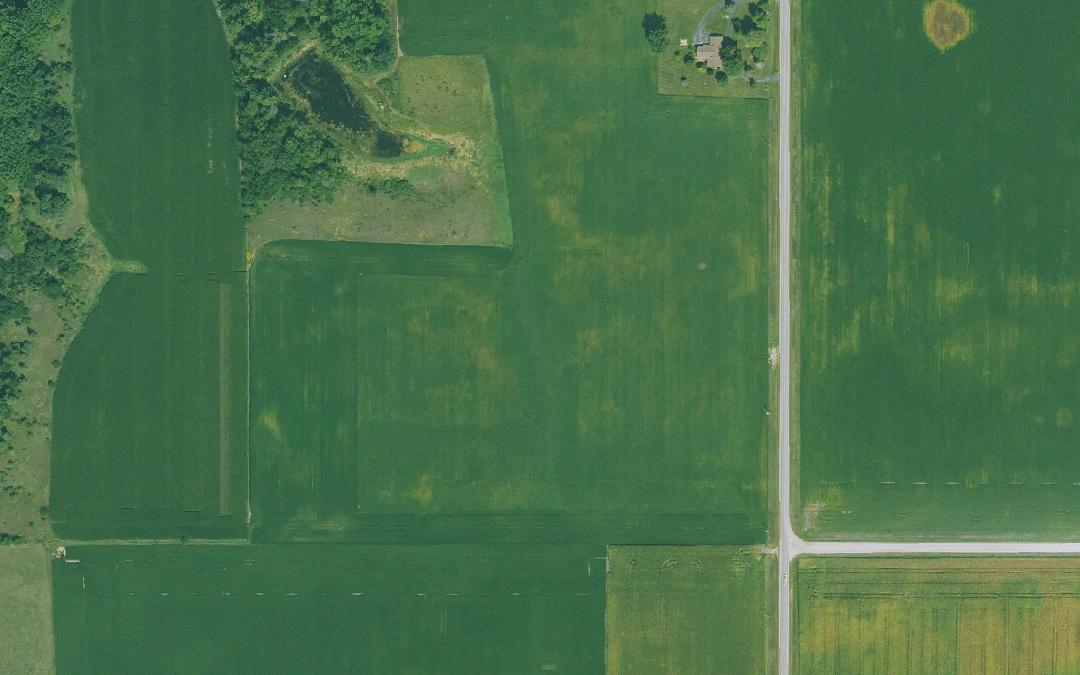
the loop, live
One real field, the price of what it grows, and the season's kept figure counting up. The photograph is aerial imagery of Story County, Iowa, flown 2023-08-30; the price is the world's, and dated; the figure is the register's own arithmetic.
the field
120 acres
corn · crop share, 50/50 · Story County, Iowa
the crop is
$5.42/bu
July 2026 — an observation, not a tick
the season would keep
$41,408
$345/acre if it closed today at that price — and some seasons lose money
rain, last seven days
2.37 in
3,026 growing degree days since 1 May, 150 days into the season
The idea, in three steps
1
Put in dollars.
USDG buys a share of a season at whatever the vault holds. Nothing to pay to come in, and nothing locked up that the vault does not actually have.
2
The fields do the work.
Seed, rain, sun, a combine at three in the morning. The costs come out first — inputs, hauling, the farmer's share — and what is left is the season's income rather than a profit, because a season can lose money.
3
Your share is worth more.
Nothing lands in your wallet: the price of a share rises instead, and you redeem in dollars whenever the vault holds them. The register prints how much is idle and how much is out on the season.
What exists today, and what does not
Real, and checkable
- Fields across states, each with the basis of its yield printed under it: some carry the county's own USDA figure, and the rest are a regional average standing in for a lease that has not been signed yet.
- The Weigh-In arithmetic: the same multiplication, in the same order, with the same truncation LandVault.recordSeason checks a report against.
- Prices from FRED, weather from Open-Meteo, imagery from the USGS's NAIP programme — each with its own date, unit and source.
- Two contracts, LandVault and GreenZ, with 17 tests between them, one of which calls every owner function and asserts that the money never moved.
- A register that prints the season rather than a forecast: the acre, the basis of the yield printed under it, the price with the date it was read, the weather over the ground — and, when a price could not be read at all, the fields left out and named rather than given a plausible number.
Not yet — and this page will keep saying so
- No farm has signed.Every operator line reads “not yet signed”, and every farm name is a placeholder drawn from the ground it stands on.
- No vault is deployed — not on Robinhood Chain and not on its testnet, so there is nothing to buy a share from. The local chain runs the contract, and that is the whole of it.
- No season has been settled, so nothing on the register has been through a Weigh-In and no season's income has been counted. Nothing has been earned and nothing has been lost.
- No ten-year yield range.The county's own history needs a USDA NASS key the register does not hold yet, and the page says that rather than interpolating one.
- No audit. Never imply one. Seventeen tests is a sentence about diligence, not about assurance.
The token
the door, not the product · and no promise about either
There is no token.
No contract, no presale, no whitelist, no “soon”. Nothing on this site is for sale, and nothing on this site will ever ask you to send anything anywhere. Anything calling itself $GREENZ today is not from here.
If one exists later it would be the door rather than the product, and this block is where the address, the pool, the locker, the supply and the tax terms go — filled in from the launch transaction rather than from memory.
What happens next
in order · and with no dates in it
1
A farm signs.
The counties become particular farms: a lease, an operator's name, an acreage, and a boundary the imagery can be centred on instead of a county seat. Not one has signed — which is why every farm name here is invented and every operator line reads 'not yet signed'.
2
A season is recorded.
The Weigh-In: the harvest, the costs, the farmer's share, and what reached the vault. The arithmetic is the contract's own — a report whose lines do not multiply out to the total it claims is refused, and so is one claiming money the vault never received.
3
The vault opens.
USDG in, a share out, redeemed in dollars whenever the vault holds them. On a testnet first, where a mistake costs time rather than money, then on Robinhood Chain with real money and a real farm. The register will read it through the vault's own navPerShare, never a stored figure.
4
A token, if there is one.
It would be the door rather than the product: fixed supply, no owner, no mint, and no share of the season's income — the instrument that carries that weight is the share, and it is a USDG instrument. The block above prints the address, the pool and the tax terms if it exists, and anything claiming to be it that is not that address is not us.
5
The losing seasons go up beside the winning ones.
Hail, a flooded spring, a tariff, a price that collapses between the combine and the elevator: a season that loses money gets a report in the same columns, with the same sources under it. This is the step the other four are for.
That is the whole list, in order, and none of it has a date on it. Money has to be bridged to a chain this has never touched, a treasury address has to be chosen once and never changed again, and a farmer has to sign — none of which is ours to schedule. A date this page missed would be the one kind of number it does not print. The other half is already printed: the marketplace prices each field's season out of this register's own arithmetic, and every door on it names the step above that it is waiting for.
The rules this is being built to
- 1Never show a promise. No APY, no target, no arrow going up a chart. The most emotional moment is a number arriving, and that is enough.
- 2Name real places — Story County, Iowa, not “the heartland”.
- 3Say the loss out loud, somewhere. The register prints the seasons that lost money in the same columns, with the same sources, as the ones that did — and the page's own sequence prints the same step, because a launch page that shows only the good season is an advertisement.
- 4End on the board rather than on a logo animation: the foot of the page is a sentence and a door, on the board's own black. The last thing a reader sees should be one they could read.